WDM WATER PRESSURE
The water in the pipes coming to your property is under pressure, which is important to maintain good water quality and provide adequate flows for fire protection. West Des Moines Water Works (WDMWW) is committed to providing reliable, available, and consistent water pressure for all of our customers.
To accomplish this goal, the WDMWW distribution system has been divided up into multiple water pressure zones. A network of Elevated Water Storage Tanks and Remote Booster Stations are used to manage the pressure throughout these different zones. Water pressure across the WDMWW system varies from a low of approximately 40 psi (pounds per square inch) to a high of approximately 140 psi. The large variety in pressures is due primarily to changes in ground elevation within a pressure zone. Generally, higher elevations have lower water pressures.
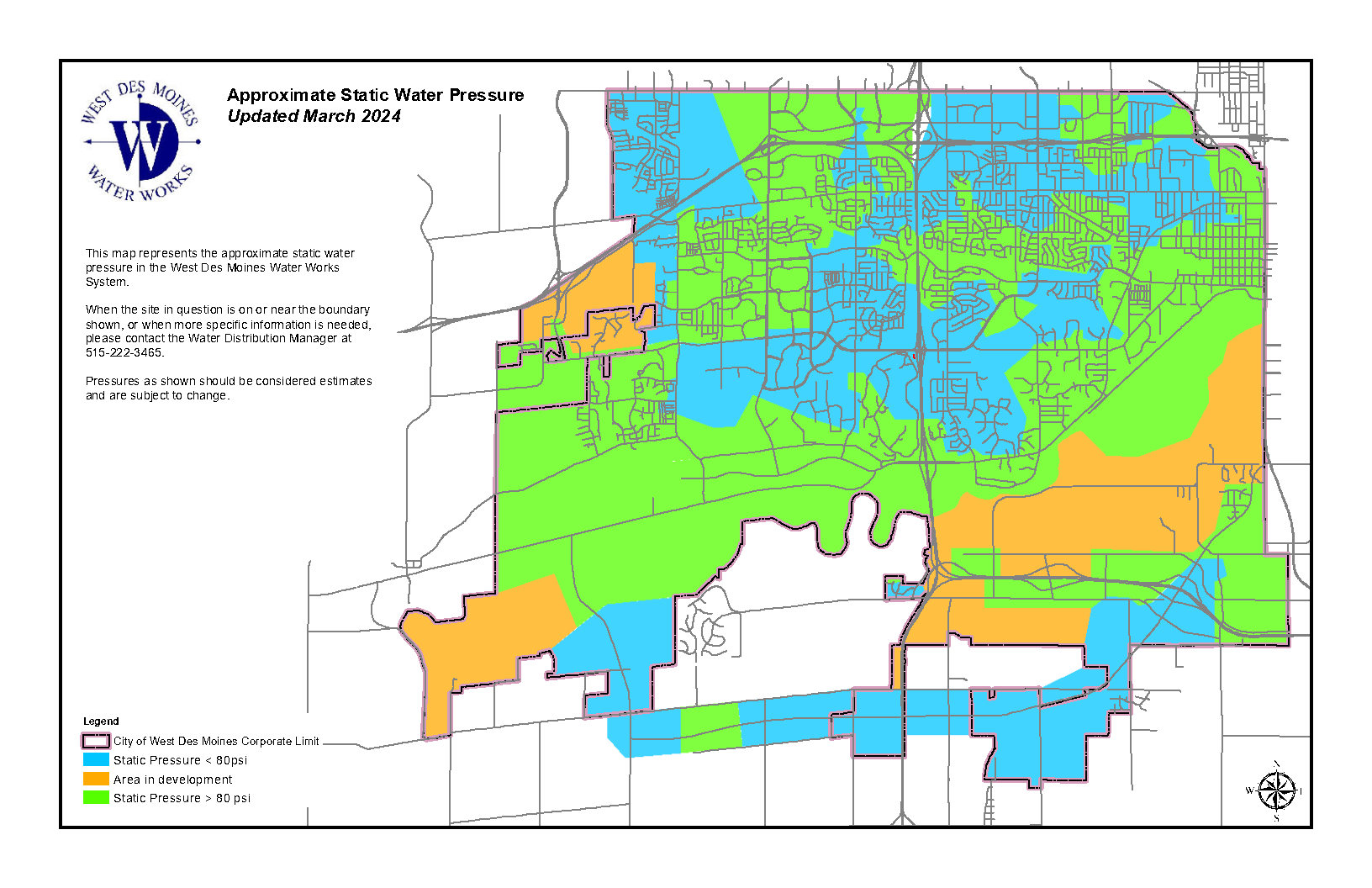
Static water pressure exceeds 80 psi in a large portion of the City of West Des Moines. A map is shown below for reference. When a property is located in or near an area where static water pressure is anticipated to exceed 80 psi, West Des Moines Water Works recommends installation of a pressure reducing valve and expansion tank.
Determining your home’s water pressure
Knowing how to check your property’s water pressure and troubleshooting common high-pressure or low-pressure problems can keep water flowing properly.
- Visit a hardware store and purchase an inexpensive water pressure gauge, which easily attaches to an outside faucet. The gauge helps you determine the on-site water pressure at your property.
- If a customer has low pressure throughout their entire home, WDMWW may send a meter technician to review the situation. The meter technician will then determine if it is a WDMWW issue or if the customer needs to contact a plumber.
High water pressure
Most plumbing professionals recommend a pressure reducing valve setting between 50 and 90 psi. Many modern fixtures are designed to have low flow, meaning the device is made to lower the output pressure at the fixture outlet, thereby limiting flow. Please keep your home’s fixtures in mind when concerns arise over water pressure from a specific point within the home.
Low water pressure
If you’re experiencing a decrease in normal water pressure at your property, the issue is typically within your own plumbing system. This list may help you identify the cause:
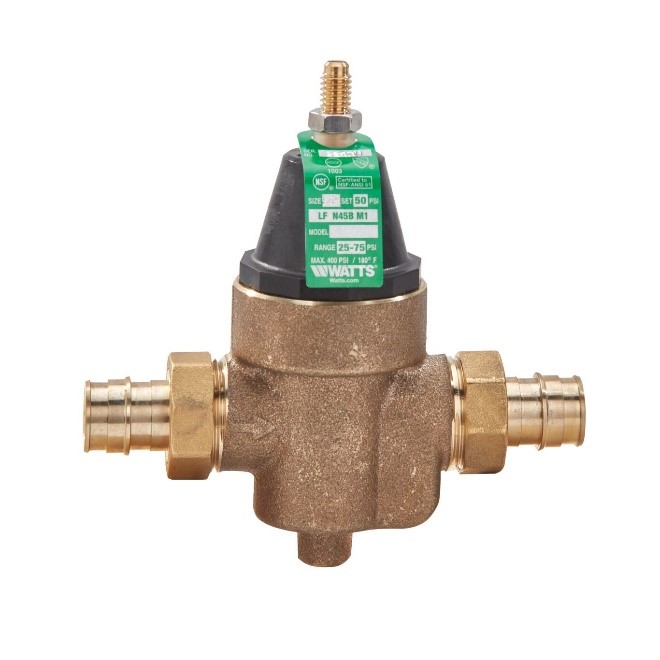
- Pressure Reducing Valve — If the low pressure is at every faucet in the home and you have a PRV installed, you may want to verify that your PRV is set appropriately. An adjustment to or replacement of the PRV may be necessary.
- If you have a PRV, it is most likely located near the water meter where the water comes into your property. While there are several manufacturers, a typical PRV looks like the example below.
- Clogged Fixture — If the low pressure is not affecting every faucet, the problem may just be a clogged or blocked faucet or shower head. Check the faucet’s screens for rust, debris, scale, or other particles that may be restricting flow. Many times, simply soaking the shower head in standard vinegar for a few hours will resolve the problem. If you have white particles in your shower head, you may have a water heater dip tube failure and a replacement may be required. You may need to consult a licensed plumber to further evaluate your water heater.
- Hot Water, Low Pressure — If the low pressure is only affecting the hot water, there could be a problem with your water heater. Check the shutoff valve near the water heater and make sure it is fully open. You may need to consult a licensed plumber to evaluate the condition of your water heater and determine if it is affecting your water pressure. Proper periodic maintenance is recommended to keep your water heater performing optimally.
- On-site Water Valve or Main Water Valve — Your home should have a valve on both sides of the water meter located where the water service pipe enters your home. These valves allow you to shut off the primary flow of water to the home. Make sure these valves are opened completely. Even the slightest closure can restrict flows and decrease the water pressure. Most homes also have valves located near other on-site fixtures, like a water heater or water softener.
- On-site Leak — A water leak on your service line can also cause low water pressure.
- Water Softeners — If you have a water softener and notice a sudden drop in water pressure, consider having a licensed plumber evaluate your water softener’s condition. One option is to temporarily put the softener on bypass and see if pressure increases. If it does, the low pressure is probably caused by the water softener, and it may need to be serviced or possibly replaced.
- Neighborhood Low Pressure – If you’ve confirmed the issue is throughout your home, talk to your neighbors! If they also notice low water pressure, it may be due to a larger issue such as a water main break. Please share this information with WDMWW Customer Service at 515.222.3460 as it may help us identify the issue and resolve the matter faster.
- Water Filters – A plugged water filter can cause a drop in water pressure. Changing the filter will resolve this problem if the filter is the cause of the low pressure.
Installation of Pressure Reducing Valves
Water pressure higher than 80 psi occurs in a large portion of the WDMWW distribution system. In these locations, a water pressure reducing valve (PRV) installed in the home or on the property can help protect your plumbing. Please note that an expansion tank must be installed on the house side of the PRV whenever a PRV is installed on a water service pipe.
A PRV reduces the water pressure coming into your home in much the same way that a surge protector protects your computer or television. Please consult with a licensed plumber who can assess your current plumbing system and recommend whether or not a PRV is needed. The most common cause of a sudden increase in water pressure is a faulty pressure regulator. The pressure regulator may need adjusting or replaced. You may want to contact a plumbing professional to inspect the regulator.
The City of West Des Moines has adopted building codes which impact the construction of residential, commercial, and industrial property in the City of West Des Moines. As of March 2024, the City has adopted the State of Iowa Plumbing Code (2021 UPC, with amendment) Where static water pressure exceeds 80 psi, the code requires the installation of “an approved-type pressure regulator” which should be set to 80 psi or less (Code section 608.2). It is important to note that whenever a pressure reducing valve is used, a properly sized expansion tank should be located immediately downstream of this valve. The pressure reducing valve and expansion tank need to be installed downstream of the water meter and – if present – a backflow device.
System Pressure Data Requests
From time to time, system users need to obtain a formal water system pressure test. This is usually related to insurance assessments, or the design of an irrigation or fire suppression system. To obtain this information, please contact the Water Distribution Manager at 515.222.3465. Tests can typically be scheduled within a few days of the request. Due to the potential for freezing conditions, tests may take longer to schedule in winter months.
Please note that WDMWW charges a fee for formal water system pressure tests. The current fee can be obtained from the Water Distribution Manager.